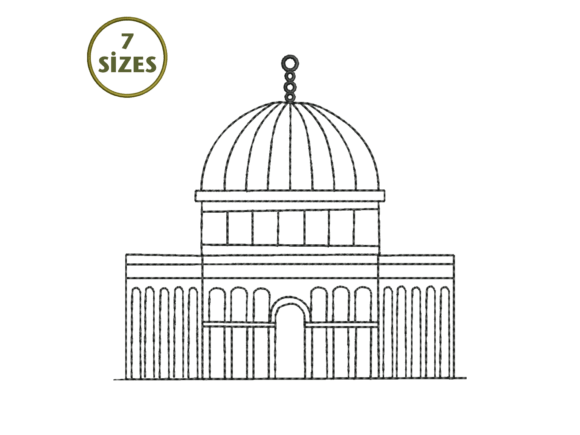
Al Aqsa Line Mosque Embroidery
A Thoughtful First Impression for Real-World Use
As an embroidery designer who’s stitched hundreds of commercial and custom orders—from boutique apparel to nursery decor—I approached the Al Aqsa Line Mosque Embroidery with both curiosity and caution. This isn’t just another decorative motif; it carries cultural resonance and visual weight. At first glance, the design reads as clean, reverent, and intentionally minimal—relying on confident line work rather than heavy fill areas. There’s a quiet dignity in its structure: balanced proportions, rhythmic arches, and subtle tapering in the minaret lines that suggest careful digitizing. It doesn’t shout—it invites closer looking. That makes it ideal for projects where elegance and intention matter more than flash: think baby blankets, linen pillow covers, or unisex aprons for faith-based small businesses.
Where It Fits Naturally in Your Workflow
The Al Aqsa Line Mosque Embroidery shines in applications where subtlety enhances meaning—not overshadows it. I tested it conceptually across several real project types:
- Tote bags & kitchen towels: Works beautifully at 3.5"–4.5" width—clean enough to hold up after repeated washing, yet distinctive enough to anchor a neutral canvas.
- Sweatshirts & crewneck tees: Performs well on mid-weight fleece and cotton blends when paired with lightweight cutaway stabilizer. The line-based nature avoids bulk, unlike dense fill-stitch mosques.
- Baby blankets & nursery pillows: Its low stitch density (inferred from clean vector-like outlines) means less thread buildup—critical for delicate skin and frequent laundering.
- Embroidered patches & cap fronts: Scales down reliably to 2.75" without losing legibility—no tiny lettering or fragile bridges to worry about. Ideal for iron-on or sew-on patches sold on Etsy or at craft fairs.
Practical Considerations Before You Stitch
This is a digital embroidery file, delivered instantly as ZIP or RAR—no physical item ships. That convenience is valuable, but it also means you’re responsible for verifying compatibility and execution. Here’s what I’d check before assigning it to a customer order:
- Hoop size & placement: Measure your machine’s standard hoop dimensions. If the design exceeds 4", confirm whether it’s meant for multi-hooping—or if scaling down compromises its architectural clarity.
- Stabilizer strategy: On stretchy fabric like knits or curved cap surfaces, use tear-away + light cutaway combo. On dark fabrics, test thread contrast—white or ecru works best for visibility without glare.
- Wash durability: Since this relies heavily on satin and running stitches (not dense fills), it holds up well—but always pre-wash stabilized fabric scraps first. Check for puckering or thread migration after one gentle cycle.
- Licensing clarity: As a Creative Fabrica embroidery download labeled under Freebies, review the product page carefully. Confirm whether the license permits commercial use of finished products—especially important if you sell embroidered tote bags or personalized gifts on Etsy.
Impact on Your Handmade Product’s Perception
Using the Al Aqsa Line Mosque Embroidery isn’t just about adding decoration—it’s about elevating intention. Customers notice when symbolism is treated with care. A well-executed version on a linen tea towel signals craftsmanship and respect. On a baby blanket, it adds quiet significance without overwhelming the piece. For handmade shop owners, that translates directly into perceived value: buyers pay more for thoughtfully curated design assets that feel personal, not mass-produced.
Photography benefits too—the clean lines reproduce crisply in natural light, making mockups pop on Instagram or Etsy listings. No heavy shadows or fuzzy edges to edit out. And because it avoids intricate applique or layered details, there’s less risk of misalignment during stitching—fewer re-hoops, fewer frustrated customers asking, “Why does mine look different?”
Honest Notes for Commercial Embroidery Use
If you’re using this for commercial embroidery—say, fulfilling wholesale orders for a boutique or creating limited-run apparel—keep these points in mind:
- Small hoop limitations: Avoid cramming it into a 3" hoop unless scaled appropriately. Some fine minaret tips may distort if stretched too far.
- Texture vs. precision: On textured fabrics like terry cloth or bouclé, consider simplifying background elements or skipping optional inner accents (if included in alternate versions).
- Thread color harmony: Stick to matte, low-sheen threads—rayon can highlight inconsistencies in line weight. Cotton or polyester embroidery thread gives softer definition.
- Printable mockup integration: Because it’s a clean line design, it layers seamlessly over digital garment templates. Great for fast turnaround product previews before stitching begins.
Final Thoughts for Designers & Sellers
The Al Aqsa Line Mosque Embroidery stands out not for complexity, but for restraint. It’s a mature choice—not trendy, not loud, but deeply functional. For embroidery designers building cohesive collections, it pairs naturally with geometric borders, Arabic calligraphy accents, or minimalist crescent motifs. For Etsy sellers, it supports storytelling: “Hand-embroidered with reverence” becomes more than a tagline when the design itself reflects that ethos.
That said—don’t skip the test stitch. Run it on scrap fabric matching your final substrate. Check how the lines read at actual size. Compare light and dark fabric mockups side-by-side. And always, always revisit the Creative Fabrica product page to confirm file details, format compatibility, and usage rights before listing your finished product.
In a market flooded with overly detailed, high-density mosque designs, this one breathes. And sometimes, in embroidery, breathing room is exactly what makes a handmade product feel human.