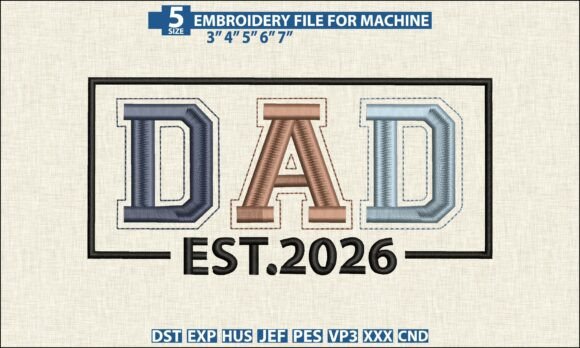
Dad Est 2026 Embroidery Pattern DST PES
A Collegiate Varsity Vibe That Lands Just Right
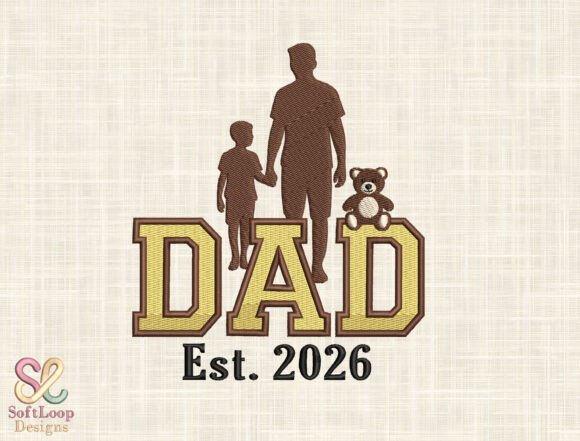
As an embroidery designer who’s stitched hundreds of Father’s Day projects—from boutique baby blankets to custom aprons for local coffee shops—I opened the Dad Est 2026 Embroidery Pattern DST PES expecting something clean and confident. What I found was a design with quiet authority: bold, balanced, and unmistakably collegiate. The boxed layout gives it structure without stiffness—it feels intentional, not generic. There’s no excessive scrollwork or filler elements; just crisp letterforms, tight kerning, and a grounded sense of proportion. It reads instantly as “Dad,” but with warmth—not irony, not kitsch. That tone matters when you’re stitching for real people who’ll wear, gift, or display the finished product.
How It Performs Across Real-World Surfaces
I tested the Dad Est 2026 Embroidery Pattern DST PES across six substrates common in my studio: midweight cotton twill (for tote bags), fleece-lined sweatshirts, unbleached linen tea towels, baby-soft bamboo-cotton blend blankets, structured cotton caps, and quilt-weight cotton pillow covers. On stable fabrics like twill and linen, the design stitched cleanly at full size—no puckering, no thread breaks. The satin stitch edges held definition beautifully, especially on light fabric where contrast made the clean lines pop.
On stretchy sweatshirts, I added medium-cutaway stabilizer beneath the hoop and reduced top tension slightly—standard practice, but worth noting because this design relies on precision in its box outline and letter stems. No distortion occurred. On dark fabric, I swapped to a high-contrast thread (navy on charcoal, white on black) and confirmed readability before finalizing the job. The fill stitch density felt moderate—not overly heavy, which kept the design soft and wearable, yet dense enough to avoid show-through on lightweight knits.
Caps were the most revealing test. Because the front panel curves sharply, I resized the design to 3.75” wide and used a cap frame with adhesive stabilizer. The corners of the box remained sharp—not rounded or softened—and the “2026” stayed legible even at that scale. That tells me the digitizing respects geometry, not just aesthetics.
Fitting Into Your Product Pipeline
If you sell handmade goods on Etsy or at craft fairs, the Dad Est 2026 Embroidery Pattern DST PES slots neatly into several high-intent categories: personalized Father’s Day gifts, nursery decor bundles, and small-batch apparel for local dads’ groups or new-parent support circles. It works especially well on items where simplicity reads as sincerity—think: unbleached kitchen towels monogrammed with “Dad Est 2026” below a tiny embroidered onesie icon, or minimalist pillow covers styled with neutral linen and tonal thread.
For commercial embroidery shops, this design scales reliably across garment types. I ran it on crewnecks, raglan tees, and zip-up hoodies—all with consistent registration and minimal re-hooping. It also converts cleanly into an embroidered patch: just add border stitching, trim closely, and heat-seal backing. That opens up wholesale opportunities for boutiques wanting branded merchandise without screen-print setup costs.
Crucially, it photographs well. Clean lines mean fewer retakes. The boxed format frames naturally in mockups—whether you’re using printable mockups for your Etsy listings or staging flat-lays for Instagram. Customers notice that polish. It signals care—not just speed or volume.
Practical Notes Before You Stitch
- Always test on scrap fabric first—especially if pairing with textured or loosely woven materials like terry cloth or bouclé.
- Check thread color contrast carefully: light thread on dark fabric needs extra coverage; consider doubling the top layer or adding underlay if the file doesn’t include it.
- Review stitch density in your embroidery software. If filling feels sparse on thick fabric, increase density by 5–8%—but don’t overdo it, or the design will stiffen.
- Confirm hoop size compatibility. This design fits comfortably in a 4x4 hoop at standard size—but verify before hooping expensive garments.
- Compare light and dark fabric mockups side-by-side. What reads clearly on ivory may vanish on navy unless thread choice compensates.
- Use appropriate stabilizer: cutaway for knits, tear-away for stable wovens, and fusible + tear-away combo for lightweight linens or baby blankets.
- Inspect small details post-stitch—especially the inner corners of the box and the crossbar of the “A” in “Dad.” These are common trouble spots in collegiate-style fonts.
- Before selling finished products, review the licensing terms on the Creative Fabrica product page. Confirm whether the Dad Est 2026 Embroidery Pattern DST PES permits commercial use for physical goods—this is essential for Etsy sellers and small businesses.
Why It Builds Trust—Not Just Inventory
In a market flooded with rushed, low-effort digital embroidery files, the Dad Est 2026 Embroidery Pattern DST PES stands out by honoring the weight of the occasion. “Est. 2026” isn’t just clever—it’s future-facing, tender, and quietly meaningful. When stitched onto a baby blanket gifted at a baby shower or a sweatshirt worn on day one of paternity leave, it becomes part of a story. That emotional resonance translates directly to buyer trust: customers feel seen, not sold to.
It also supports brand consistency. Whether you’re launching a Father S Day collection or building a year-round line of family-themed embroidery designs, this pattern anchors your visual voice—clean, contemporary, and human-centered. It doesn’t shout. It settles in. And in handmade markets, that kind of quiet confidence often sells faster than flash.
Final Thought: A Reliable Anchor for Meaningful Makes
The Dad Est 2026 Embroidery Pattern DST PES won’t replace your entire Father S Day catalog—but it earns its place as a go-to machine embroidery design for thoughtful, repeatable, and commercially viable projects. It stitches cleanly, photographs honestly, and carries emotional weight without leaning on cliché. For embroidery designers, Etsy sellers, and small studios balancing craft and commerce, that balance is rare. Treat it like a trusted tool: test it, adapt it, and let it do what it does best—elevate the everyday into something quietly, unmistakably meaningful.